Carnival HUB
Released Jan 2015 — full fleet

The pre-COVID benchmark: an independent analysis of 10 ocean cruise guest apps capturing the industry at a watershed moment — featuring BLE beacons, emerging AI assistants, new cross-platform frameworks, and our post-pandemic predictions.
OnDeck by Sourcetoad has specialized in innovative guest-facing software for the cruise and ferry industry for 15+ years. Our mission is to increase the value of both the guest's and the crew's time by building automation, communication, and self-service systems.
We offer a number of custom and out-of-the-box solutions for cruise lines to increase operational efficiencies, improve guest experiences, and shorten technology ROI cycles.
Learn moreProducts & Services
2020 is the second year Sourcetoad has published this Cruise App Report. This report was started in January of 2020 and originally scheduled to be released in late March. The change of direction that most cruise technology departments and companies have taken made much of what we had written seem insignificant.
Since the first announcements of sailings being canceled on March 12th, development teams have been working to support the changing needs of operations. As a result, we anticipate large feature releases from all major cruise lines in the next few months. App development will likely prioritize more health and safety features, contactless options, and crowd control systems.
After four months there appeared to be some limited signs of operations restarting. In light of this watershed moment, we released this report as the pre-Coronavirus benchmark.
We are publishing a snapshot of the industry before COVID-19 disrupted it — capturing all the innovation and feature races underway as apps began adopting beacons, AI assistants, card scanning, and social features at a rapid pace. Many of the pre-pandemic trends described here accelerated sharply once sailings resumed.
Note: Data in this report was collected from apps released and tested before March 12th, 2020 — the pre-COVID baseline.
The apps chosen for this report met the following criteria:
Data was collected from app analyses via VirusTotal, discussions with professionals in the cruise industry, first-hand experience, articles, online reviews, and demonstration videos.
Android APK reverse engineering — maintained by Sourcetoad's Director of Engineering.
Mobile Security Framework — static analysis for Android and iOS.
APK analysis to supplement decompilation.
Diffing app versions to identify changes between releases.
This report covers 10 ocean cruise guest apps captured before March 2020. Crystal Cruises joined the roster with a new iOS-only app in November 2019. Royal Caribbean International and Celebrity Cruises continue to share a codebase through their shared IT department.







Fleet availability. Not every ship in a cruise line's fleet necessarily supports a mobile app — fleet availability varies by ship retrofit, technology investment, and onboard network capability. Crystal Cruises' Esprit uses a separate app and falls outside the scope of this report.
Each app we analyzed contained a fairly broad selection of features and options. This year we saw more features moving from unusual to common, and an increase in stand-out features that differentiate individual brands. Features are grouped into Common (almost standard), Less Common (in at least two apps), and Stand-out (differentiating, or found in only one app).
Features shared by the majority of apps reviewed.
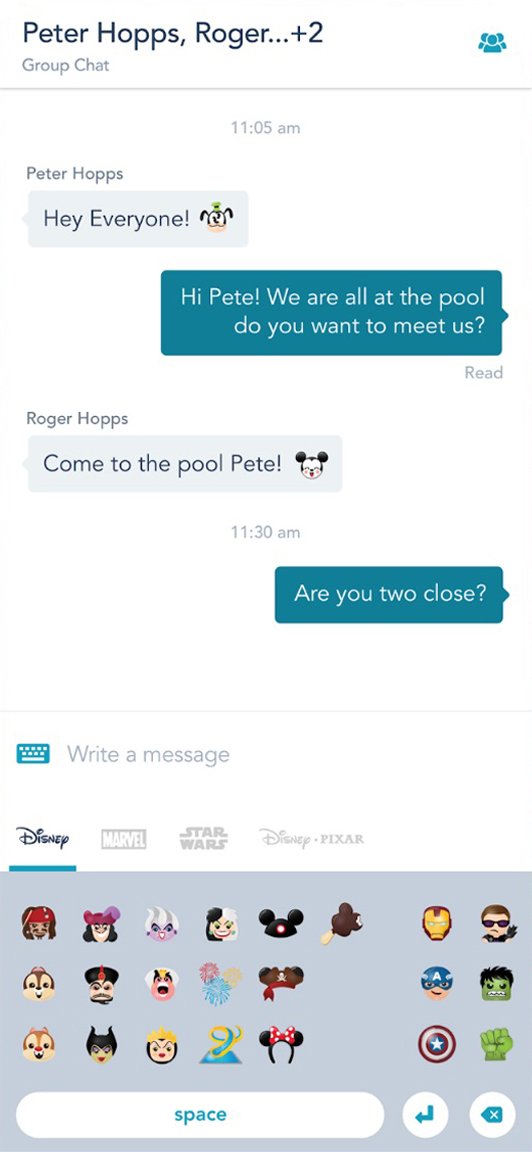
Chat has now been adopted by the majority of apps reviewed. Although a couple of cruise lines still charge small fees, it is increasingly becoming a free feature.
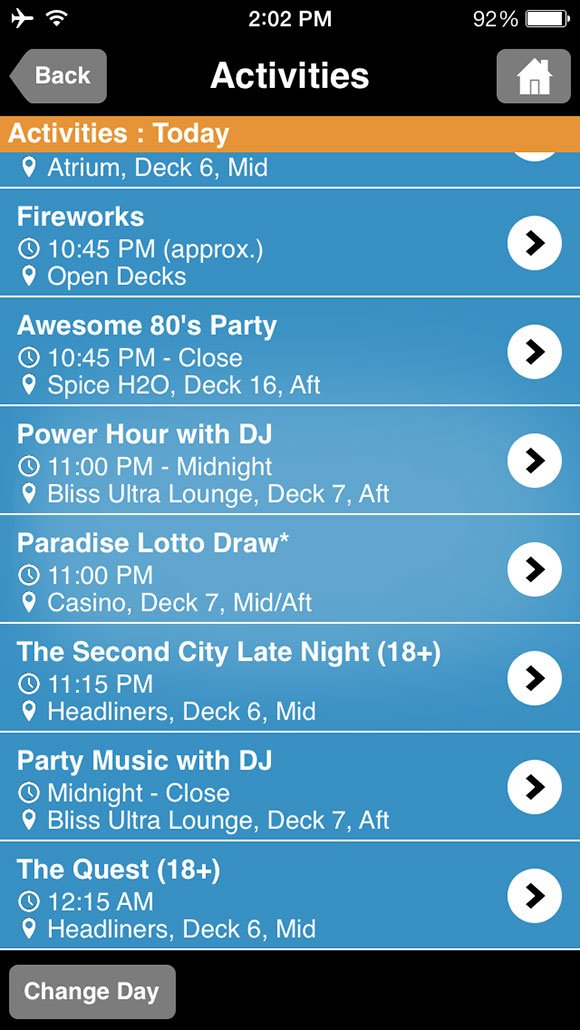
The main stop when planning activities for each day. You can usually add, book, or mark an event, which then moves to your personal calendar.
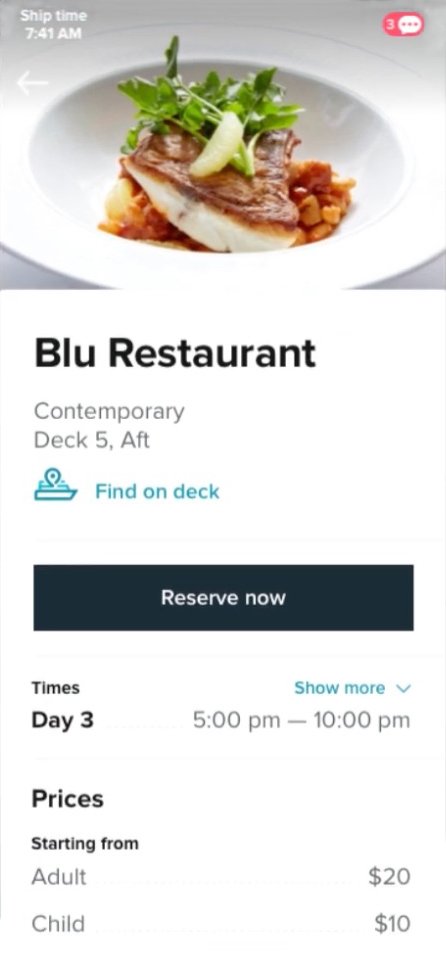
Every app has at least some information on dining options — hours, menus, images, locations, dress attire, reservations, and reservation cancellation.
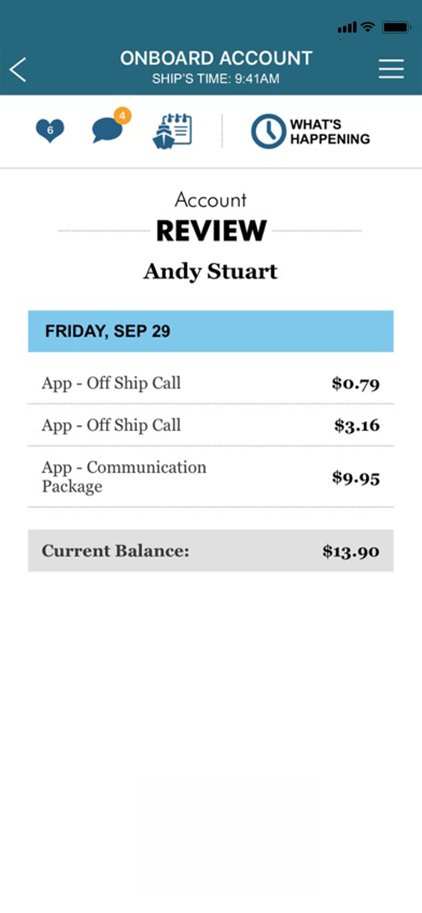
An itemized billing statement that updates when guests make purchases — important for avoiding bill shock at the end of a cruise.
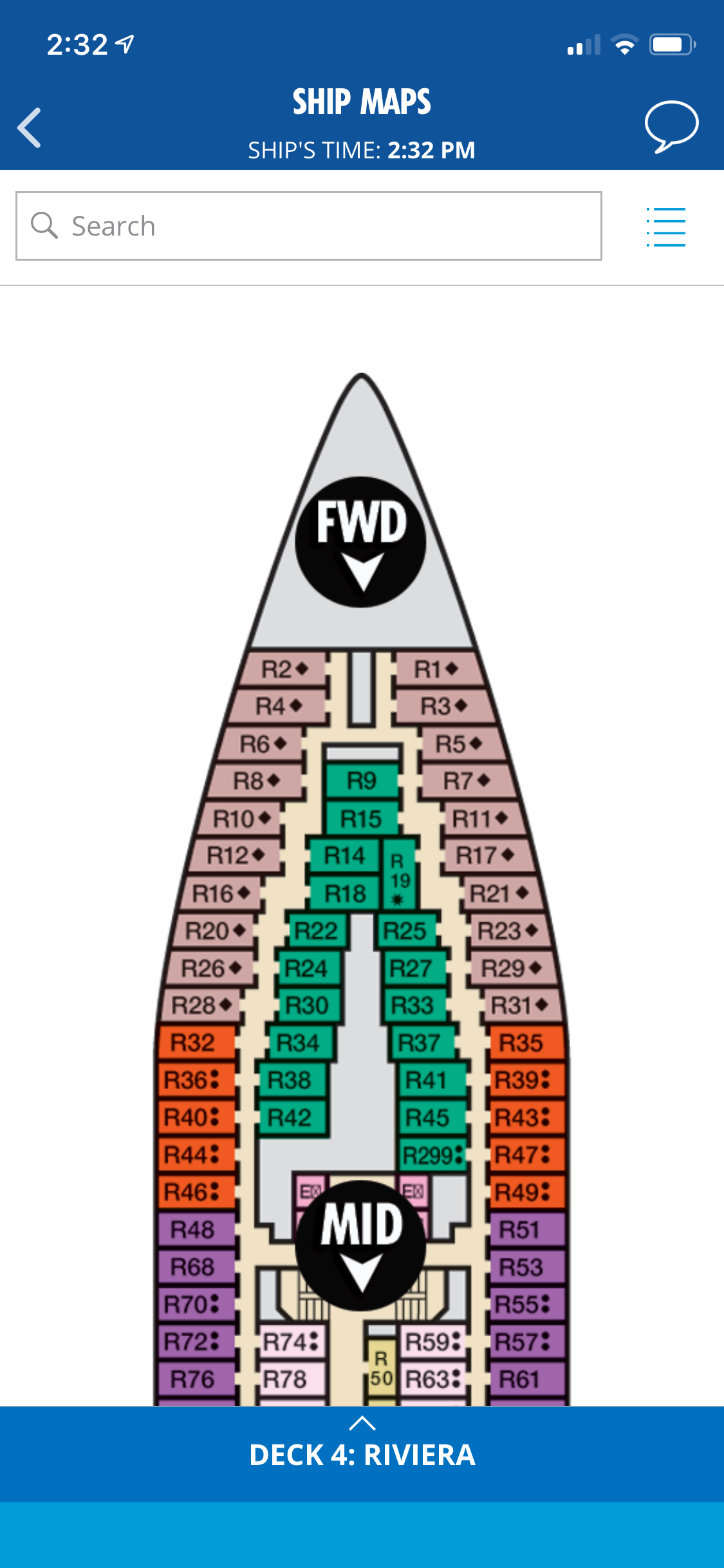
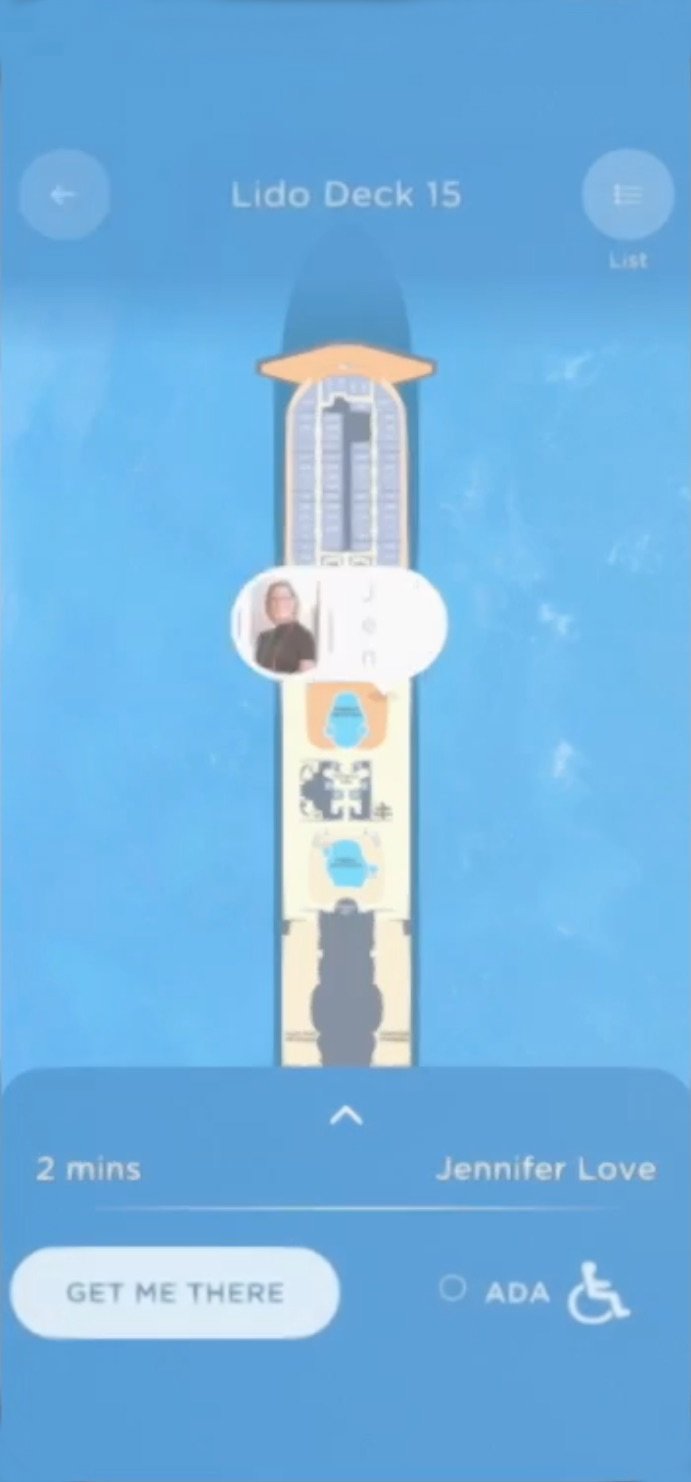
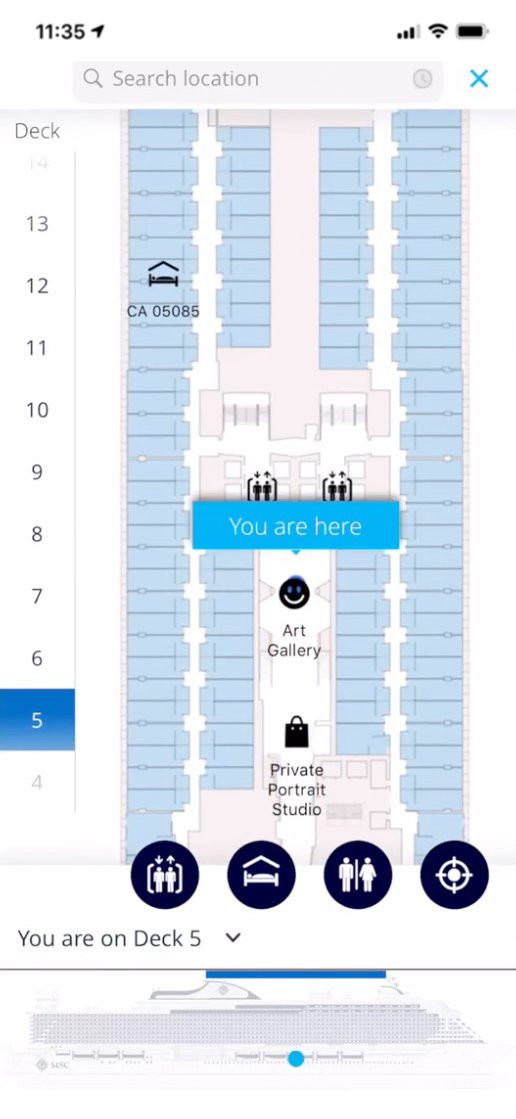
Deck plans are a ubiquitous feature and a critical guide for guests who are navigating their way around the ships.
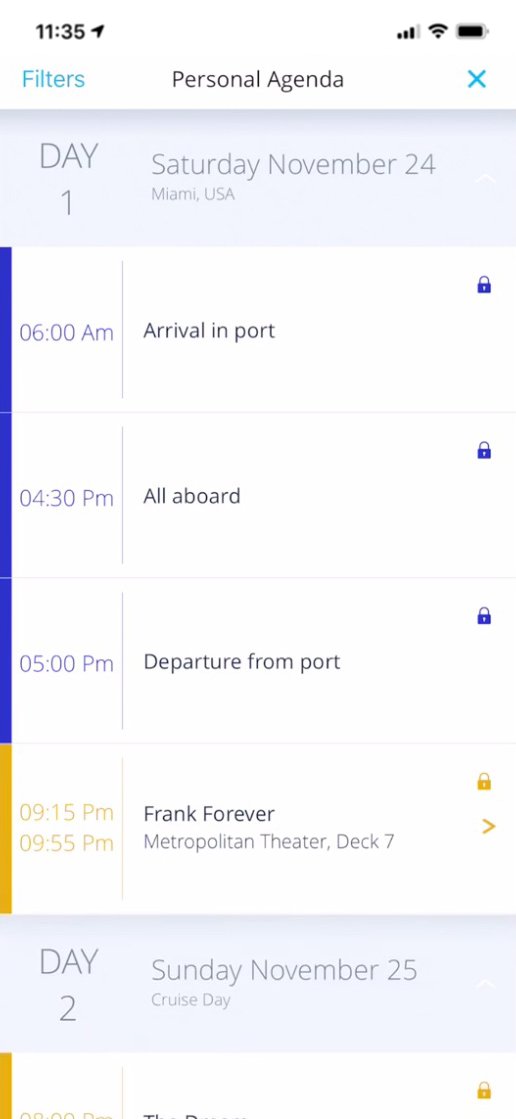
The guest's customized schedule. Once an activity has been chosen or booked, it appears on this calendar.
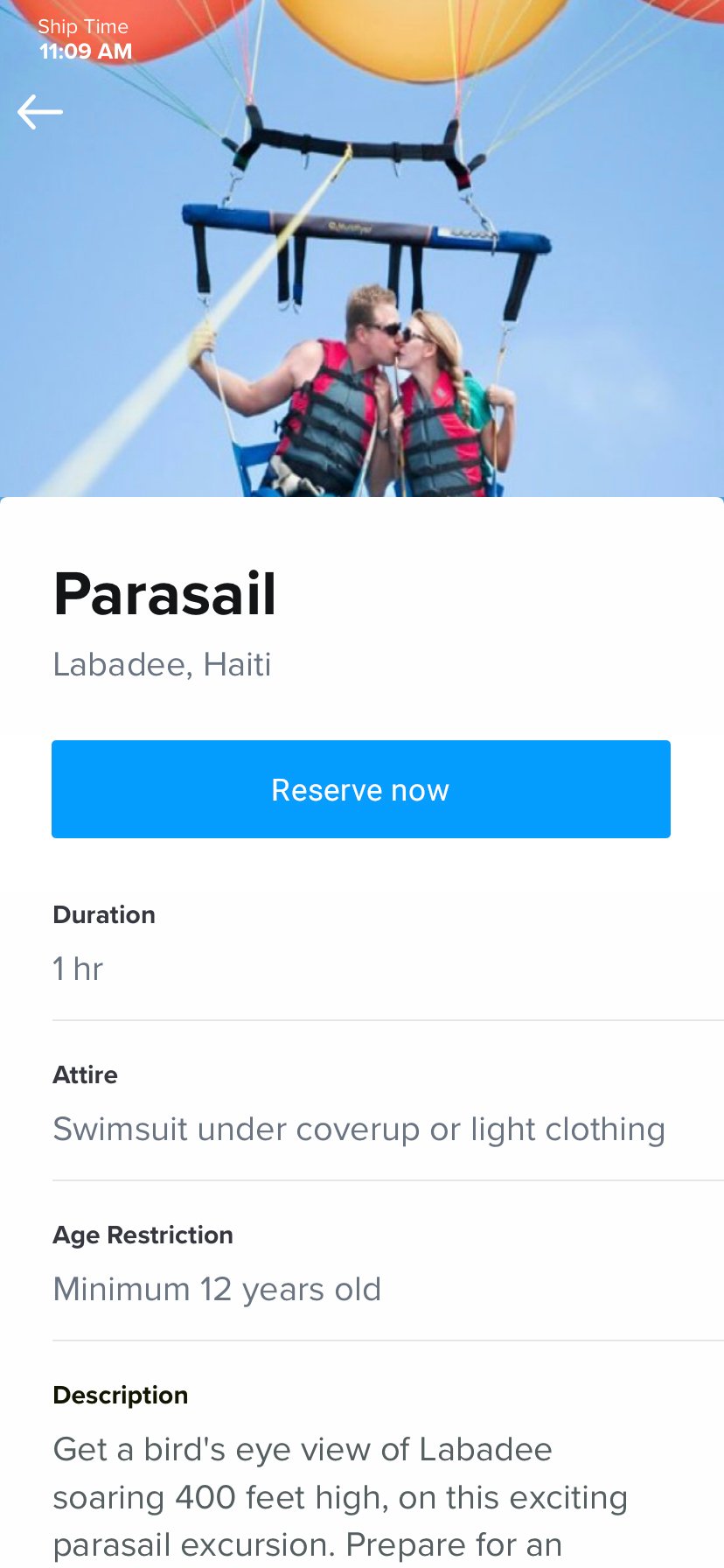
Almost all of the mobile applications reviewed allow guests to both research and book an excursion directly from their device.
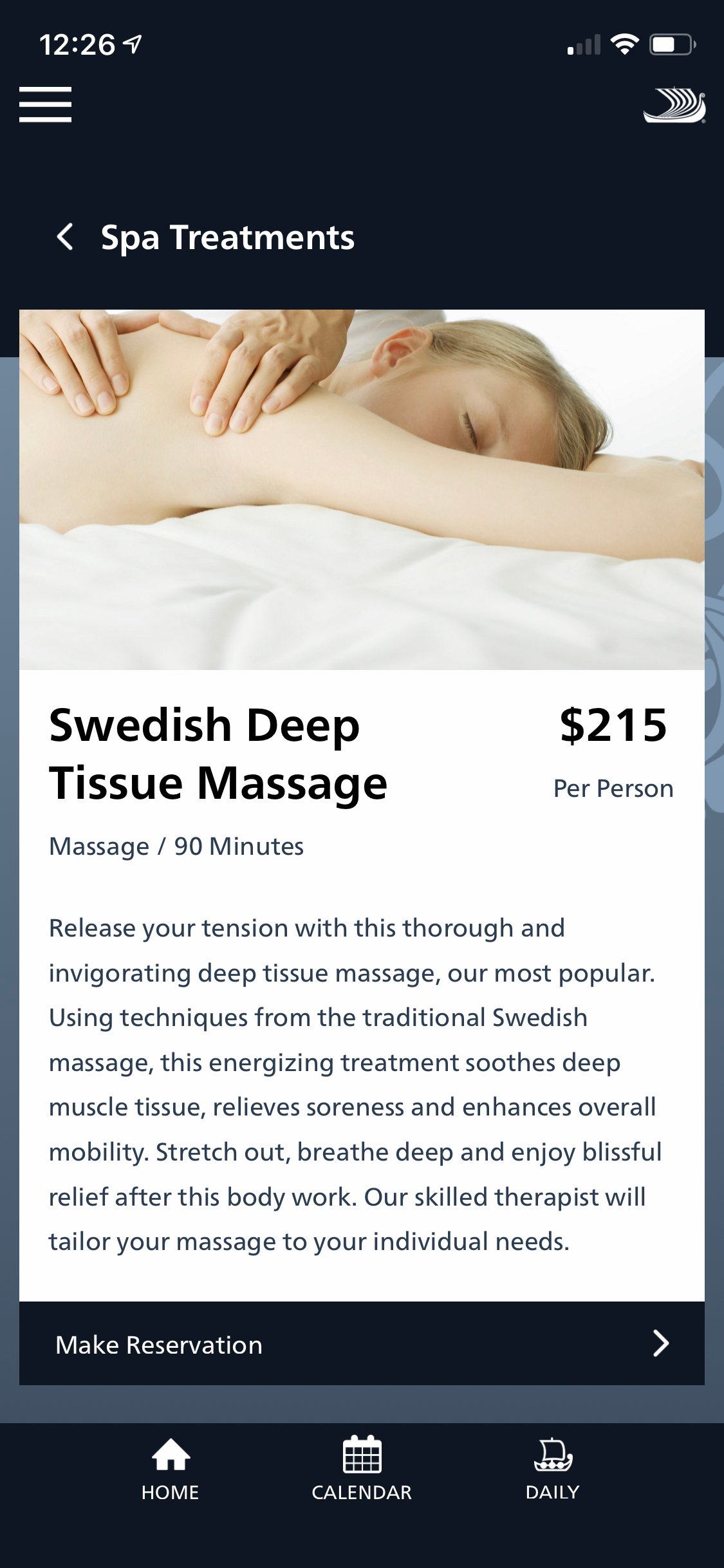
Most cruise lines have some kind of spa service — on most apps guests can view the offerings, and on a few they can make reservations.
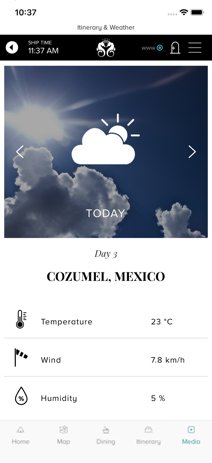
Having the current weather and forecast available is a useful feature, especially when planning a shore excursion or deciding on activities for the day.
Shared by at least two apps — likely to become standard within a couple of years.
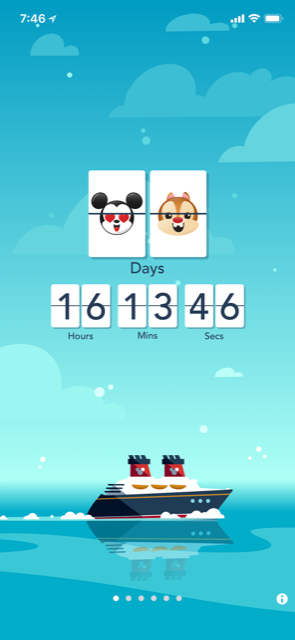
A pre-cruise countdown is being introduced to more apps, helping to build anticipation for guests' upcoming cruise.
Wearables are making it possible to keep track of family and friends aboard the ship — especially valuable for families with children.
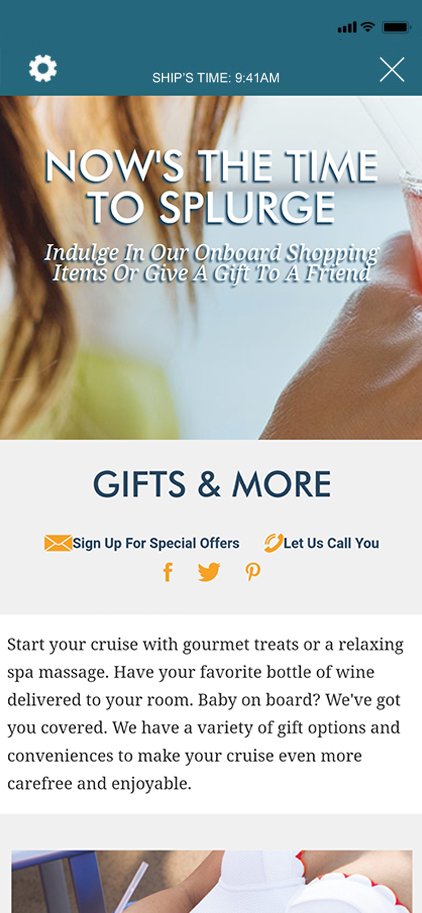
Apps are beginning to offer more options for purchases, including gifts before guests even board the ship.
A couple of apps use a Bluetooth Low Energy beacon system to help guests find their way around the ship, with contextual location-based information.
Differentiating features found in only one app.
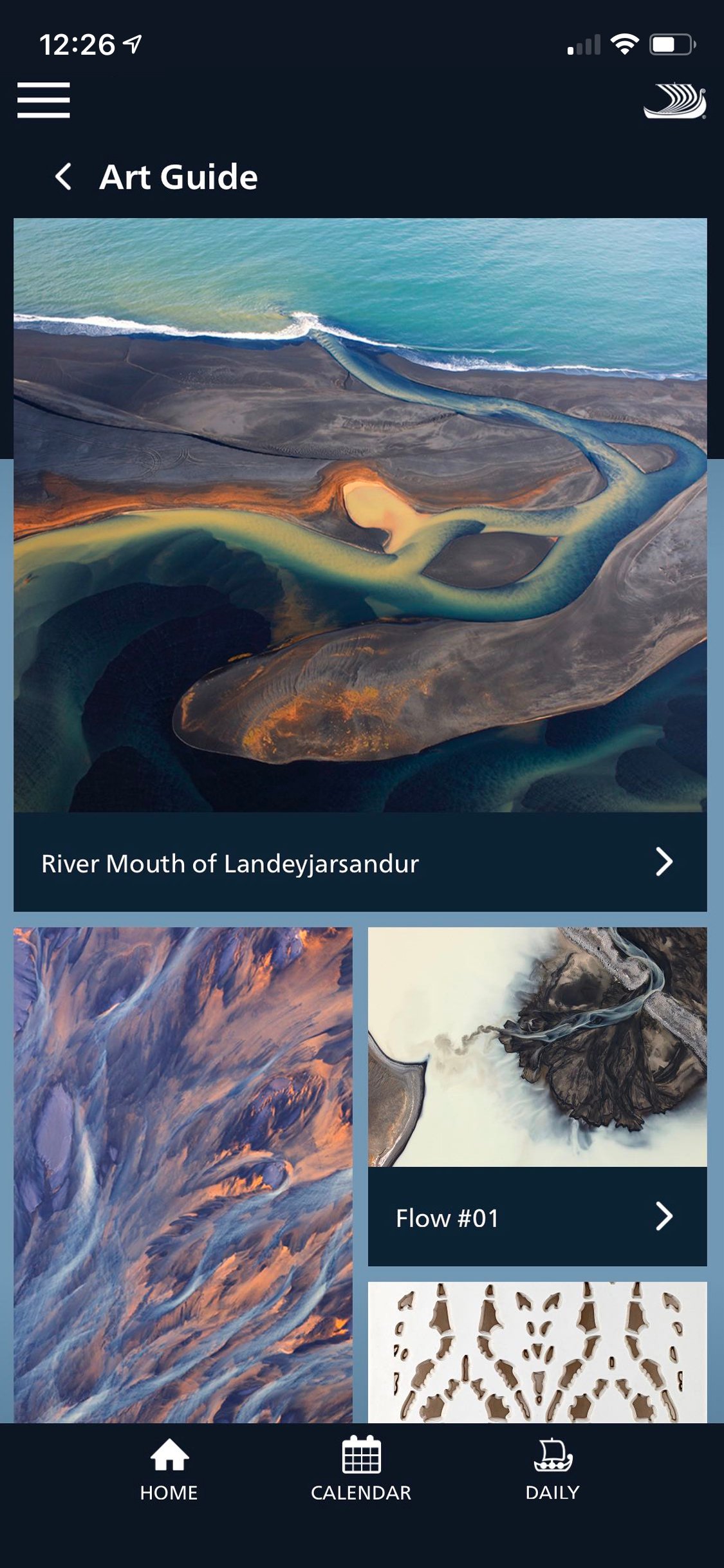
Viking Voyager includes an audio art guide — guests can listen to clips about historical pieces, works of art, and different areas of the ships.
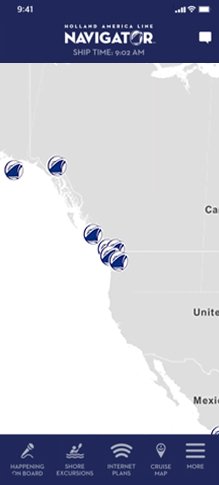
The Holland America Navigator Cruise Map feature lets guests see where all Holland America ships currently are, including their own.
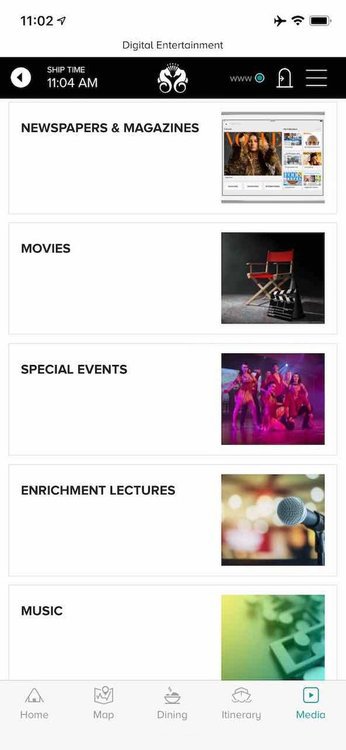
Crystal's app contains a full digital entertainment suite — movies, music, and enrichment lectures. Crystal and Princess also offer their own branded channels and shows via their apps.
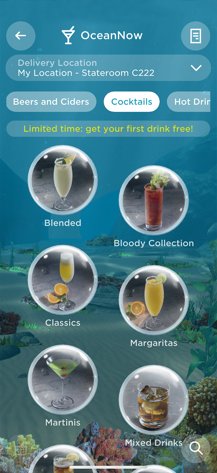
MedallionClass allows guests to order drinks or merchandise from anywhere on the ship. The order is sent to the closest bar or store location, and delivered directly to the guest.
Cruise Norwegian allows unlimited calls to other guests for a one-time fee of $9.95 USD. Guests can also call home for $0.79 a minute.
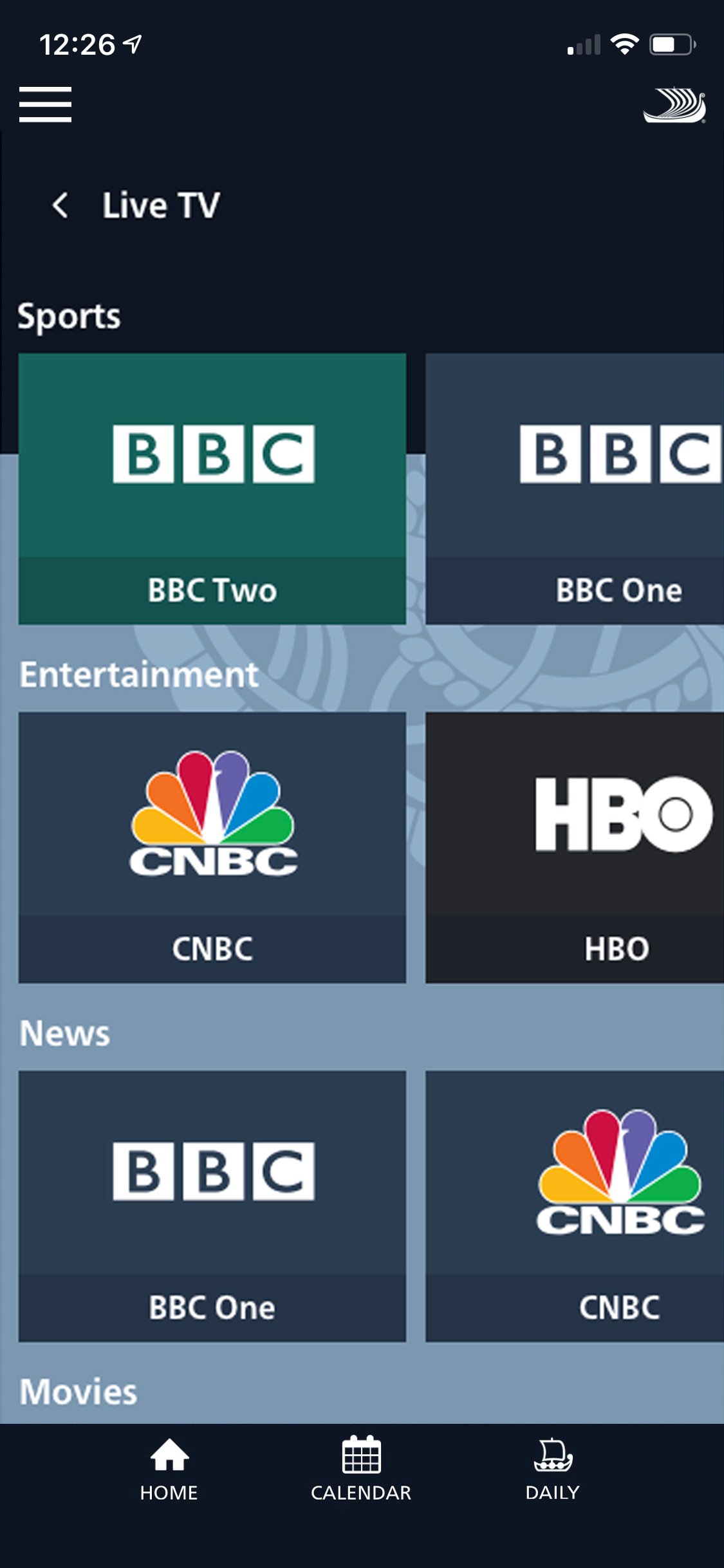
Viking Voyager includes live television that works anywhere on the ship — guests can sit by the pool and watch the news on their phones or tablets.
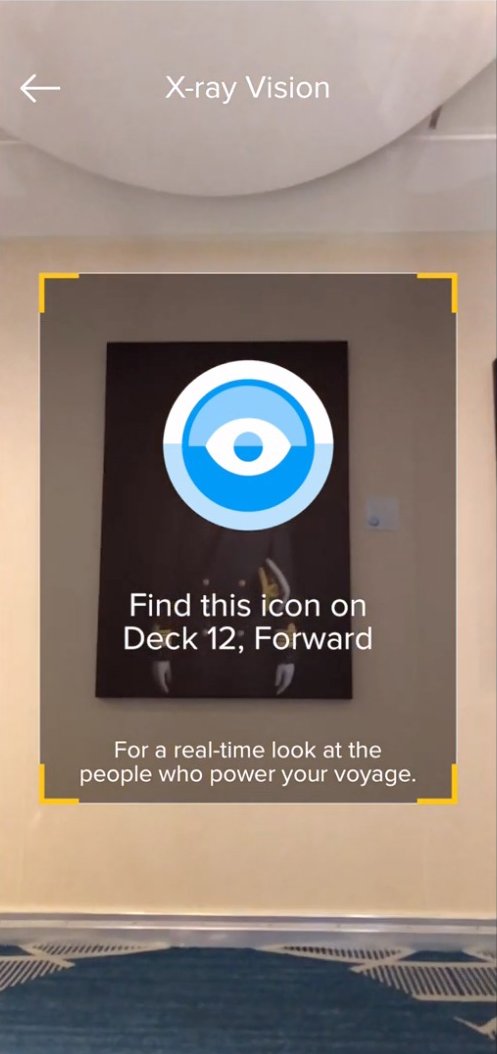
Royal Caribbean International has incorporated an AR-like experience into their primary guest app. Guests can virtually look through walls to explore areas not usually accessible, like the galley and the bridge.
In 2019, almost all apps were predominantly native — written in Java or Kotlin for Android and Objective-C or Swift for iOS, with one React Native exception. In 2020, two new alternative technologies joined the industry alongside a significant growth in Bluetooth Low Energy beacon adoption.
New in 2020, Cordova is a cross-platform technology that allows developers to write code using standard web development tools (HTML5 and JavaScript) and run it in an app wrapper. This is similar to how most interactive TV apps work — the application runs a headless browser and loads the web content into the frame. Development time and complexity are significantly lowered, with the trade-off in speed and functionality.
Also new in 2020, Unity was primarily developed as a hybrid 3D gaming engine — but a number of non-gaming mobile apps have been built with it. Unity allows for more radical interface designs, as well as a single codebase deployed across iOS and Android. It is still an outlier as a development choice, but its appearance in a cruise app is a sign of the industry's willingness to experiment.
Bluetooth Low Energy beacons allow a Bluetooth-enabled device (such as a smartphone) to detect small radio devices nearby and send an identifier back to a central server. Beacon functionality increased from very little support in 2019 to appearing in at least three cruise apps in 2020. The Android Beacon Library was found in a number of apps, and the increase in BLE libraries indicates significant infrastructure investment is underway.
Potential BLE applications
Cruise applications have an uncommon constraint: they act differently based on the network the guest has joined — onboard versus standard internet. An external settings file works by requesting a file from a specific domain with configuration flags. Once connected to the onboard network, this file returns different flags than it would over a standard internet connection. This can be expanded greatly beyond simple configuration flags, and we noticed this pattern of development in many of the applications.
A couple of cruise apps currently use a VoIP phone system for making onboard calls. Some applications, however, have a SIP client library bundled inside them without a phone feature. When connected to the internet, push notifications are straightforward — but on a ship, background pushes can take up to an hour. A SIP library enables real-time background push notifications (because VoIP apps need messages instantly for incoming calls), even if there is no actual VoIP system. This is risky: Apple has previously banned apps that use this approach and it has been deprecated in later iOS versions. Apple now requires all VoIP apps to use PushKit, which requires connectivity to Apple's servers.
Decompiling each app surfaces the third-party libraries bundled into the binary. Below are the most significant tools found in 2020 — a year defined by BLE expansion, new bug tracking options, and the early appearance of AI assistants.
Found bundled in apps, with indications that at least three other lines are experimenting with virtual chat assistants. Virtual assistants need trained conversations built on readily available data sources and APIs — complex in a disconnected shipboard environment.
Java bytecode optimization and obfuscation tool. Makes it significantly harder to reverse-engineer source code from a compiled APK — any prying eyes have a lot more work to do.
Found in multiple apps. An HTTP proxy allowing developers to proxy onto the ship to debug issues on a real device. Finding Charles SSL certificates in production builds is a security concern — see Security tab.
Found in select apps. Sourcetoad's suite of onboard and shoreside software modules — iTV, digital signage, captive portal, mobile app creation, IoT device management, crew rosters, and PMS front ends.
Found in 2+ apps. Open-source enterprise CMS used to deliver marketing content and images to the app. Also likely used as an EFSS (enterprise file synchronization and sharing) tool to coordinate shoreside digital assets for synchronization to onboard systems.
Discovered in several apps. Accenture has extensively publicized their involvement in the Carnival Medallion project, and appears to be offering both full application development and augmentation of in-house development teams across the cruise space.
Found in 2 apps (full SDK). The leading provider of cabin door lock systems in the cruise industry. Previous mentions in apps were partial; the reemergence of full SDKs in Android binaries strongly hints that mobile room key rollout is imminent.
Found in multiple apps. Detects crashes and sends details to a specified location — even storing errors offline and uploading when connectivity is restored. Critical when developers may be thousands of miles from the ship.
New to 2020 bug tracking. Similar to Crashlytics — the company has rocketed to success in the last three years and is one of the fastest-growing SaaS companies in the world.
The primary embedded card-scanning SDK in the industry. BlinkID and BlinkCard allow developers to capture ID documents and credit card information from device camera scans to speed up the check-in process.
Found inside select cruise apps. Allows developers to import credit card information from a device's camera. An open-source product backed primarily by PayPal.
Found in more than one app. A free mobile chat SDK — evidence that some lines are prepared to be the first movers in passenger-to-passenger chat. Once standards are worked out at one brand, others follow quickly.
Several security concerns appear consistently across the apps analyzed. Combined with outdated security measures seen on shipboard guest networks, the industry remains vulnerable. These findings were consistent across multiple apps in 2020.
Many of the apps include test — or "shim" — data inside them. This is essentially a text file containing a fake passenger's details, calendar, folio, restaurant menus, available spa treatments, and shore excursion offerings. The reason this data is included is so Apple (or other testers) can test the app without connecting to a PMS or shoreside test database. The risk: this data could expose vectors of attack for hackers by providing insight into internal onboard operations and API structures.
About 50% of the apps investigated contained clear-text usernames and easily visible passwords. Unlike the Google Play store, which relies solely on automated tests, Apple has real people review apps. Because most cruise apps are designed to only work shipboard, testers need a way to trigger "onboard mode" with fake credentials to log in. This leaves open the possibility that someone could log into the apps without paying for a ticket to board the ship.
We discovered a number of applications that contain a Charles SSL certificate, suggesting multiple cruise lines use this type of live debugging on production ships. Leaving debugging proxy certificates in production builds means traffic on those ships could potentially be intercepted by anyone with a copy of the certificate. This is a development convenience that becomes a security liability when not removed before release.
A note on scope. Our analysis is based on static reverse engineering of Android APKs. We do not perform dynamic testing, network-level attacks, or any access beyond the publicly available binary. The findings above represent configuration and bundling choices, not active exploits. Cruise lines should seriously consider a number of measures to plug some of the more easily exploitable gaps in their defenses.
Last year's report made six predictions about where cruise app development would go. Here's how each one played out — in a year that nobody expected to end the way it did.
We predicted more offline features — map tiles, guidebooks, language packs — would be added to cruise apps. Although there was an increase, it was not as significant as expected.
We predicted a significant increase in pre-departure content — ship tours, videos, onboard booking systems. At least two cruise lines drastically increased their shoreside features, and three more have similar features in the works.
We predicted post-cruise uses would include surveys, enhanced content, and marketing messaging. This has turned out to be low on the priority list — though signs remain that development is still in progress at several lines.
AR and VR systems are still fairly unusual in cruise apps. There was one new instance — virtual ship tours and AR wall features — but the technology is better suited to a younger demographic than what some lines primarily serve.
We predicted a large increase in chat and messaging features. While the more speculative predictions (finding chess partners, meeting people with similar interests) have not come to pass, social features have been one of the largest industry-wide developments of the year.
Some movement on digital newspapers and reduced paper waste, but most predictions have not come to pass. Many of the health and safety sustainability predictions made in 2019 may now be pushed to the forefront by COVID-19 pressures.
There is an increasing number of stand-out features, and we have identified several emerging trends among the various brand categories. COVID-19 is clearly going to be the largest driving factor in mobile app changes for the cruise world for the foreseeable future.
COVID-19 will shape development across three categories:
Reducing reusable paper onboard will serve both surface hygiene and environmental goals. Paperless receipts are already an option on many cruises — expect an increase in paperless daily newsletters, activity announcements, waivers, food and beverage menus, tent cards, and stateroom compendiums. Paperless menus in particular could soon become ubiquitous, significantly reducing operating costs and staff time.
A large amount of potential exists for the addition of virtual and AI assistants in future cruise app releases. Providing users with the ability to text or talk to a bot for basic needs could significantly reduce the burden on human staff. These assistants are more likely to take the form of chat tools inside mobile apps than an actual in-cabin device — but the data infrastructure to power them remains the primary challenge.
Climate controls, virtual remote controls, touchless door locks, and automated blinds and curtains have already been seen in some form on various cruise lines. As these technologies become easier to implement and control systems become more cost-effective, we predict broader adoption. Many of these changes may also be driven by health and safety concerns — reducing a passenger's exposure to public surfaces and shared devices.
The future of the entire cruise industry is uncertain at the moment, but very few large industries are as well-positioned to invent their way out of a crisis. Technological innovation has been strongly embraced as a competitive advantage in the cruise world. The challenges created by the COVID-19 pandemic are likely to inspire a unique ecosystem of ideas and ignite a new round of feature races.
Looking at the pre-COVID development trends, we can see a number of features that were becoming industry standards. Interactive shoreside content has quickly become standard throughout the industry — but a simple cruise countdown screen is soon going to be below passenger expectations. Social features, mainly shipboard for now, have also become must-haves for most of the large, family-oriented brands.
The pandemic will delay all but the most agile development teams from implementing features that were priorities in the pre-COVID world. A team working on BLE cabin door locks will almost certainly have been redirected to work on health questionnaires or paperless daily newsletters.
Patterns in new technological advancements are emerging: card scanning, chat systems, and AI or decision engine systems for passengers are the most likely contenders for becoming ubiquitous over the next few years. A more diverse set of development tools and platforms is also being seen in production, with React Native appearing to be the next likely competitor to the widely adopted native platforms.
Get in touch