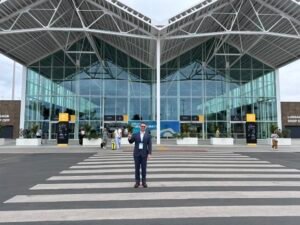

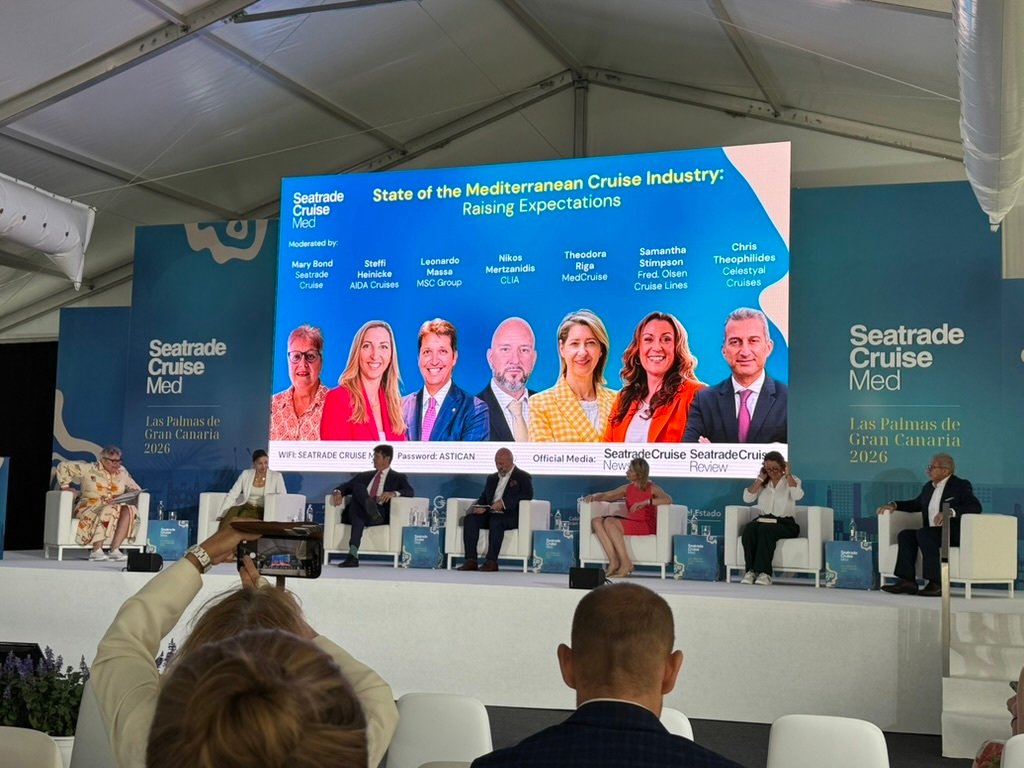

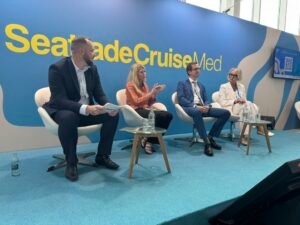
The OnDeck team recently traveled to Las Palmas for Seatrade Cruise Med, where more than 2,000 cruise professionals gathered to talk about where the industry is headed. This year’s conference covered everything from sustainable growth and shoreside infrastructure to artificial intelligence, destination management, and the changing expectations of cruise guests. Those are big subjects, and two days at a conference certainly aren’t enough to settle them. But they are enough to notice patterns.
For us, some of the most interesting conversations at Seatrade had a common thread: cruise ships are becoming more technologically sophisticated, but realizing the value of that technology increasingly depends on what happens beyond the ship. Ports need infrastructure capable of supporting newer vessels. Destinations need better information about how cruise tourism affects their communities. And new technologies like AI need to solve actual operational or guest problems, rather than simply demonstrate that they can.
Here are three ideas we came home thinking about.
The ship is ready. The shore isn’t.
One of the clearest examples of the relationship between shipboard investment and shoreside readiness is shore power. Cruise lines have been steadily adding the ability for ships to connect to shoreside electricity while in port. According to CLIA’s 2026 Environmental Technologies and Practices report, 193 CLIA-member ships now have shore-power connectivity, up from 55 in 2018. Another 47 ships are slated for retrofits, while 39 newbuilds are expected to include the technology.
The corresponding infrastructure on land is much less widespread. CLIA reports that only 40 cruise ports worldwide currently have at least one berth equipped with onshore power supply, representing fewer than 3% of the ports cruise ships visit. European regulation should accelerate that investment—major EU ports will be required to provide onshore power supply by 2030—but today there is still a substantial gap between what a growing number of ships can use and what many ports can provide.
That doesn’t mean ports are standing still. Seatrade itself highlighted shoreside infrastructure as one of the major issues facing the Mediterranean, and MedCruise data presented around the event indicates significant infrastructure investment is being considered across the region. The challenge is that ships and ports operate under very different economic and political conditions. A cruise line can evaluate an investment against fleet operations, fuel efficiency, guest experience, revenue, and brand goals. A port may need to coordinate utilities, regulators, municipalities, public funding, local communities, and infrastructure plans measured in decades rather than product cycles.
We think there is a digital version of this same problem. Cruise ships have become sophisticated technology environments. Guests move between mobile apps, interactive television, digital signage, messaging platforms, excursion systems, and other connected experiences. But the connection between the ship, terminal, and destination is not always nearly as seamless. Information can still pass between organizations through manual processes, while the guest can leave a highly connected ship and enter a terminal with comparatively little digital infrastructure supporting the next stage of the journey.
This is why “port infrastructure” increasingly means more than berths, terminals, roads, and electrical connections. Those things remain essential, but there is also a digital infrastructure layer emerging around them. Better data exchange, more useful terminal technology, and stronger connections between shipboard and shoreside systems can all help make the transition from ship to destination feel less like crossing a technological boundary. The ship may be ready. Increasingly, the question is what needs to happen on shore to take advantage of that readiness.
We need better data about what happens after guests leave the ship.
Destination management was another major theme at Seatrade, and for good reason. Mediterranean ports are under pressure not simply to accommodate more passengers, but to demonstrate that cruise tourism creates lasting value for the communities receiving those passengers.
That represents an important shift in how the industry talks about growth. In one of Seatrade’s closing discussions, panelists argued that the future success of Mediterranean ports will increasingly be measured by the value cruise activity leaves behind and by how local communities experience it, rather than passenger counts alone. The same conversation acknowledged a persistent problem: large groups of visitors are still often being sent to the same attractions at the same times.
Managing that problem requires knowing where people actually go. Cruise lines have a relatively clear picture of guests who purchase organized excursions. They know what was booked, where the excursion is going, when it leaves, and approximately when the guest will return. But the picture becomes much fuzzier for independent guests. Once someone walks off the ship and decides to explore a destination on their own, much of that visibility disappears.
That leaves some surprisingly important questions unanswered. How far do independent guests travel from the port? Which neighborhoods and attractions receive them? Are they spending money primarily around the terminal, or are the economic benefits spreading farther into the destination? Are efforts to disperse visitors actually working?
Those questions matter because destinations are being asked to make decisions about transportation, signage, pedestrian routes, infrastructure, attractions, and visitor management. Better information could also help ports and tourism authorities make a stronger case for where infrastructure investments would have the greatest impact.
Technology could help fill some of that gap. One possibility we discussed after Seatrade is allowing guests to voluntarily share location information through a cruise app, with that information aggregated into anonymous movement patterns for destinations. Instead of identifying where a particular passenger went, a port or tourism authority could see that, for example, visitors tend to cluster in one area while rarely reaching another.
There are obvious privacy considerations, and they should be part of the design rather than an afterthought. Participation would need to be explicitly opt-in, individual guests should not be identifiable, and there should be a clear benefit for the guest who chooses to participate.
But the broader idea is worth exploring. The industry spends a great deal of time discussing visitor dispersal, sustainable tourism, and the economic value cruise brings to destinations. Better measurement could help move some of those conversations from assumptions toward evidence. We think the independent guest is one of the most interesting data gaps in cruise right now, and we’ll explore it in more depth in a separate post.
AI is interesting. Useful AI is more interesting.
Artificial intelligence was, unsurprisingly, all over the Seatrade agenda. “AI & Frictionless Travel” was one of the conference’s headline themes, while the show floor included sessions devoted specifically to practical AI applications for ports and smarter destinations.
The discussions covered some genuinely interesting possibilities, including passenger-flow prediction, personalization, itinerary planning, and using AI to better understand what guests want. In a closing Seatrade panel, speakers specifically pointed toward AI and other technology as tools for improving personalization as cruise experiences continue moving away from standardized sightseeing toward more individualized experiences.
However, there is an important distinction between predicting something and knowing what to do about it. Suppose an AI system can predict that a terminal, gangway, attraction, or area of a ship is likely to become crowded 20 minutes from now. That’s useful only if someone has also decided what operational response that prediction should trigger. Do you redirect guests? Change transportation timing? Send a message? Adjust staffing? If nothing changes as a result of the prediction, then we have created a sophisticated way to tell ourselves something interesting.
One area where we think that approach has immediate potential is destination content. Cruise operators already have enormous amounts of useful information available to guests: recorded port talks, enrichment lectures, excursion descriptions, destination videos, maps, historical information, and experts who have spent years learning these places. The problem isn’t necessarily a shortage of content. Often, it’s getting the right piece of content in front of a guest when it becomes useful.
Imagine a guest who is arriving in Dubrovnik tomorrow and is interested in architecture and local food. Instead of navigating through several menus and watching an entire port lecture, the guest could ask what they should know before going ashore. An AI-powered interface could draw from material the cruise line already has, surfacing relevant portions of port talks, destination information, excursion content, and other approved resources.
That’s a fundamentally different proposition from adding a chatbot simply because AI is fashionable. It starts with a guest need and uses the technology to solve it. For us, that’s the more interesting AI conversation. The question isn’t how much artificial intelligence the cruise industry can deploy. It’s where AI can remove friction, improve a decision, surface something useful, or create an experience that wasn’t practical before.
The opportunity between ship and shore
Looking back, these three takeaways are more closely connected than they initially appeared. Shore power is about connecting increasingly capable ships to infrastructure that can support them. Better destination data is about connecting what happens onboard with what happens after guests walk down the gangway. Practical AI is about connecting all of the information and technology the industry already possesses with a specific human or operational need.
In each case, the interesting problem exists at the connection point. That’s an area we’re particularly interested in at OnDeck. We spend a lot of our time building technology for cruise ships, but increasingly the opportunities we see aren’t confined to the vessel. They involve ports, terminals, destinations, and the systems and information that need to move among them.
Over the next few posts, we’re going to dig deeper into some of those questions, starting with one that came up repeatedly after Seatrade: What do we actually know about independent cruise guests once they walk off the ship?
The answer may be less than the industry would like. Figuring out how to close that gap—responsibly—could be useful for cruise lines and destinations alike. If you’re working on ways to better connect shipboard systems, destinations, guest experiences, and shoreside technology, we’d love to compare notes.